DEHAUSS DEVELOPMENT ON THE EXPERIENCE OF RECONSTRUCTING BUILDINGS IN THE HISTORICAL PART OF ODESA
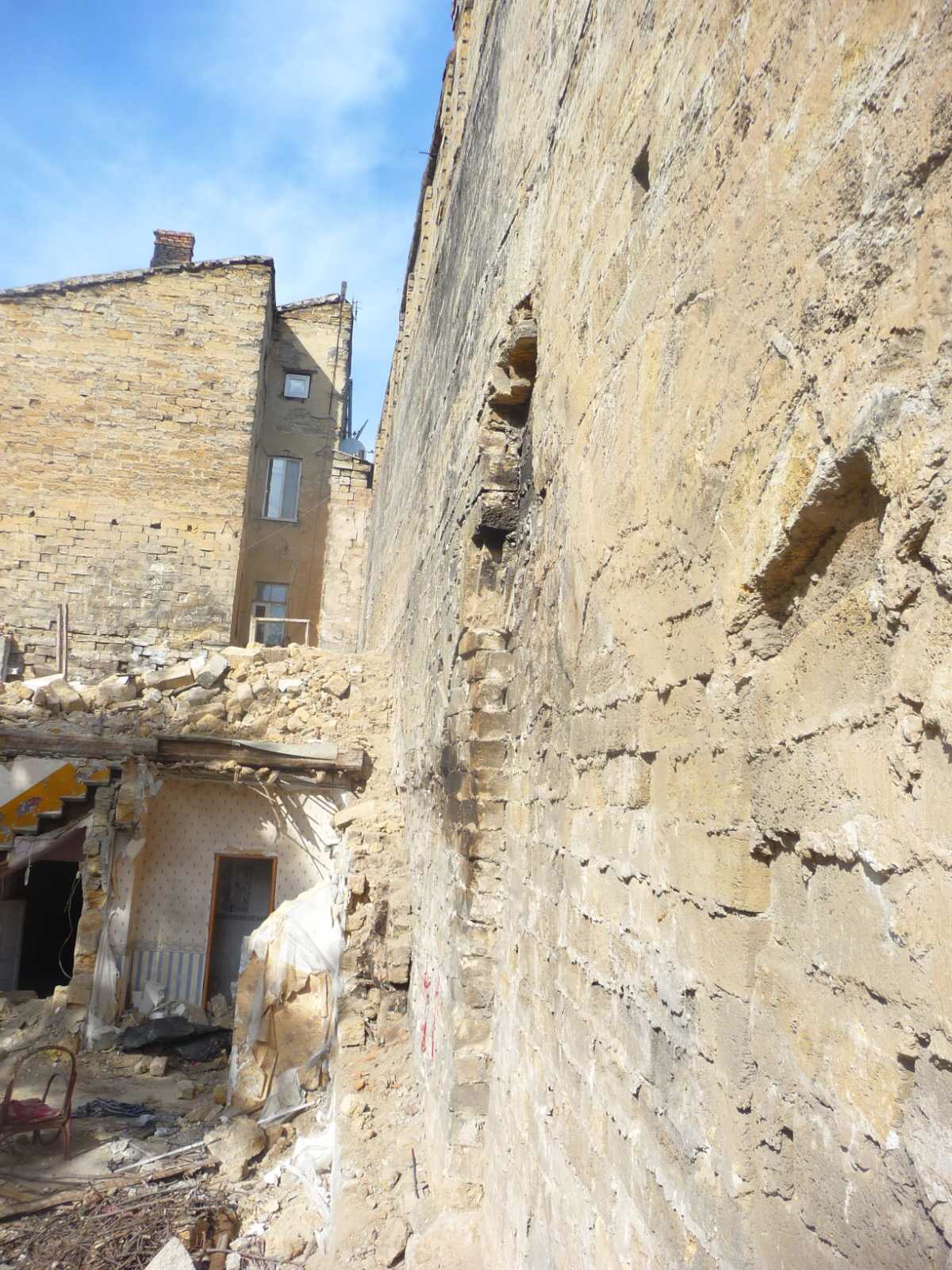
DEHAUSS Development Group of Companies has participated in a number of reconstruction and restoration projects of historical buildings and structures in Odessa, where we applied various strengthening methods and technologies, which will be discussed in today’s article about the problems of preservation and threats of collapse of part of the historical buildings in the center of Odessa.
We want to draw attention that after the recent accidents in 2020 in the historical part of the city, developers have been burdened with a share of responsibility, and now both the public and authorities require them to restore the surrounding housing stock during work on their construction site!
In our opinion, this holds one of the most important potential opportunities that can lead to a comprehensive solution to the issue of outdated residential development. But let’s return to this issue later.
The old housing stock, as it is commonly called, most of the historical buildings in the central historical area of Odessa, largely consists of buildings made of Odessa limestone-shell rock in masonry with lime-sand mortar.
The quality of samples extracted by us during the restoration and reconstruction of shell limestone buildings showed that the strength of limestone-shell rock masonry varies from M4 to M8. Shell rock becomes soggy and loses its strength characteristics, dissolves. Analysis of joints showed that after ~100 years of operation, unfortunately, the joints do not have great strength and the joint material itself has very low strength from M0 to M6.
In other words, the joint mortar is a dusty-clay loose substance that has no binders, and the masonry can be dismantled by hand with minimal effort.
Photo of building walls on Novosilskogo Street.
The masonry could be dismantled by hand without effort.
In such situations, the masonry stands only due to its own weight, masonry material and its spatial rigidity, due to the interlocking of elements, alternation of stones in the masonry mass.
With such building condition characteristics, a very dangerous situation is possible undermining of the foundation by water during leaks from utility systems. Due to loss of support and inability of masonry to work as wall beams, such situations lead to progressive collapse of masonry, the masonry crumbles in its volume pushed out by floor beams towards the collapse.
We, along with citizens, could observe such a situation last year in collapsed buildings on Torgovaya Street and Nakhimov Lane.
In our opinion, on Torgovaya Street, the building collapse that occurred was a case of gross violation of construction work without strengthening the neighboring building, which was tilted towards the work site. The demolished adjacent structure was a retaining structure due to the mutual inclination of buildings towards their adjacency.
Photo of collapsed building on Torgovaya Street. Photo credit dumskaya.net 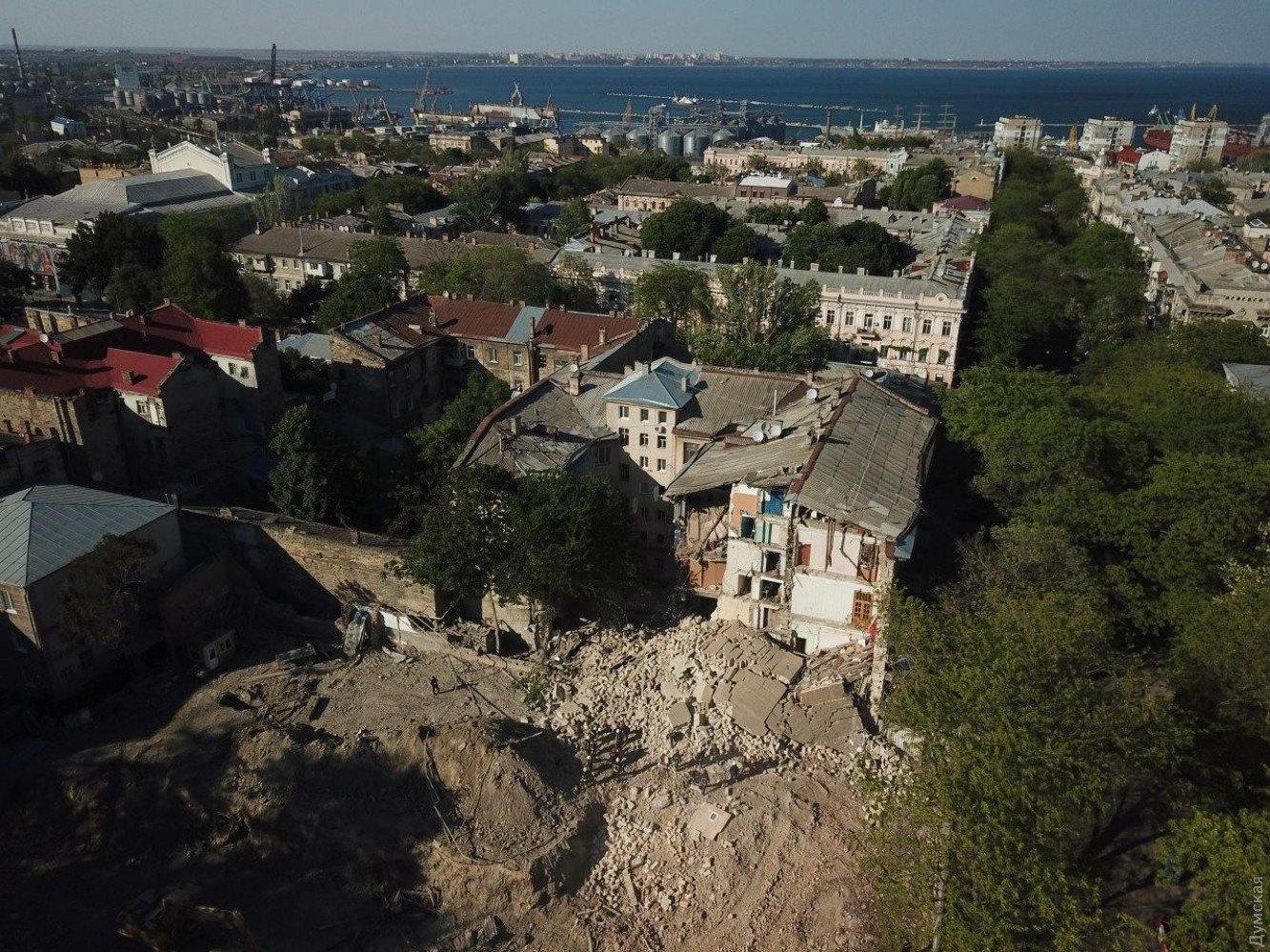
And on Nakhimov Lane, there was an unforeseen erosion of the base of the corner part of the foundation wall and collapse of the building corner with subsequent destruction of partially renovated arched window openings.
At the time of collapse, the lintels reinforced with angle frames were not finally welded and collapsed at the place where angles were cut to give an arched shape. In our opinion as an outside observer, in case of final installation of reinforcement, the fact of possible collapse might not have occurred.
Photo of collapsed building at the intersection of Kanatnaya Street and Nakhimov Lane. Photo credit dumskaya.net 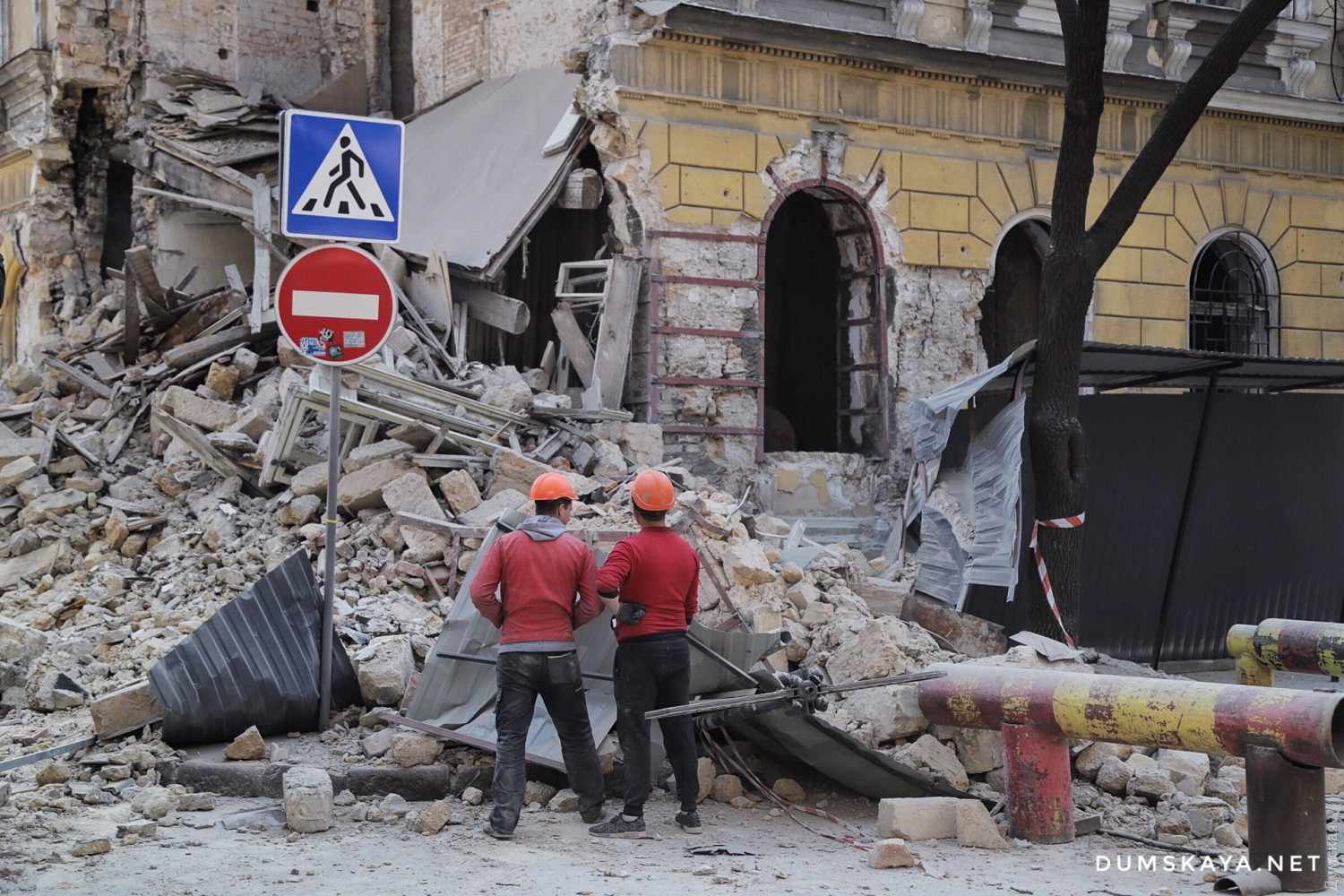
We can also note another common problem in old buildings – floor beams are often affected by rot from water-carrying utilities and heating pipes, and attic floor beams are also not in the best condition, as numerous leaks in roofing material and ventilation duct joints saturate the slag fill and as a fact – the fill is affected by fungus that eats away at the wood over many years.
In case of dilapidated or emergency buildings that do not represent historical or cultural value – according to our calculations, it is not economically feasible to preserve the building, since restoration often turns out to be more expensive and more time-consuming than demolition and new construction.
The cost of complex works on strengthening and reconstruction of buildings in the historical center, depending on complexity, can vary from 100 to 250 USD per sq.m.
As we have already written, Odessa buildings of the old housing stock have rather low strength characteristics of wall masonry materials and floor strength. We start each new reconstruction, restoration or major repair project with research. The technical condition of the inspected object is critically important for us. The priority criteria that allow us to make decisions in projects where progressive collapse is possible are zero probability of human casualties and material damage. In case of emergency condition of the building (category 3) with physical wear of main load-bearing structures more than 50%, it is more rational to keep the preserved architectural elements and facade forms, while making the structural, load-bearing part completely new.
When undertaking restoration work, we must be extremely careful about all surprises that may await us during construction work and be ready to make construction decisions and make changes to project documentation.
Based on the results of our research, the walls of all our reconstruction projects required reinforcement.
In old buildings, we used the following reinforcement methods: – injection of polymer resin solutions into cracks – cementation of cracks – concrete encasement using reinforcement cages while preserving the core section of masonry and increasing stability of masonry material – shotcreting with high-adhesion cement mortars to strengthen shell rock. In some cases, repointing joints with subsequent filling with cement mortars, partial restoration of joint depth from both sides of the wall is also possible, which allows increasing the overall load-bearing capacity of masonry.
We also want to show an example of strengthening shell rock walls with arched vaults. Basement parts of many buildings were built with such arched vaults, and in conditions where pipes leak on them, these structures come into a very poor state. This is an example of strengthening at one of the objects in Odessa at Gogol Street 12.
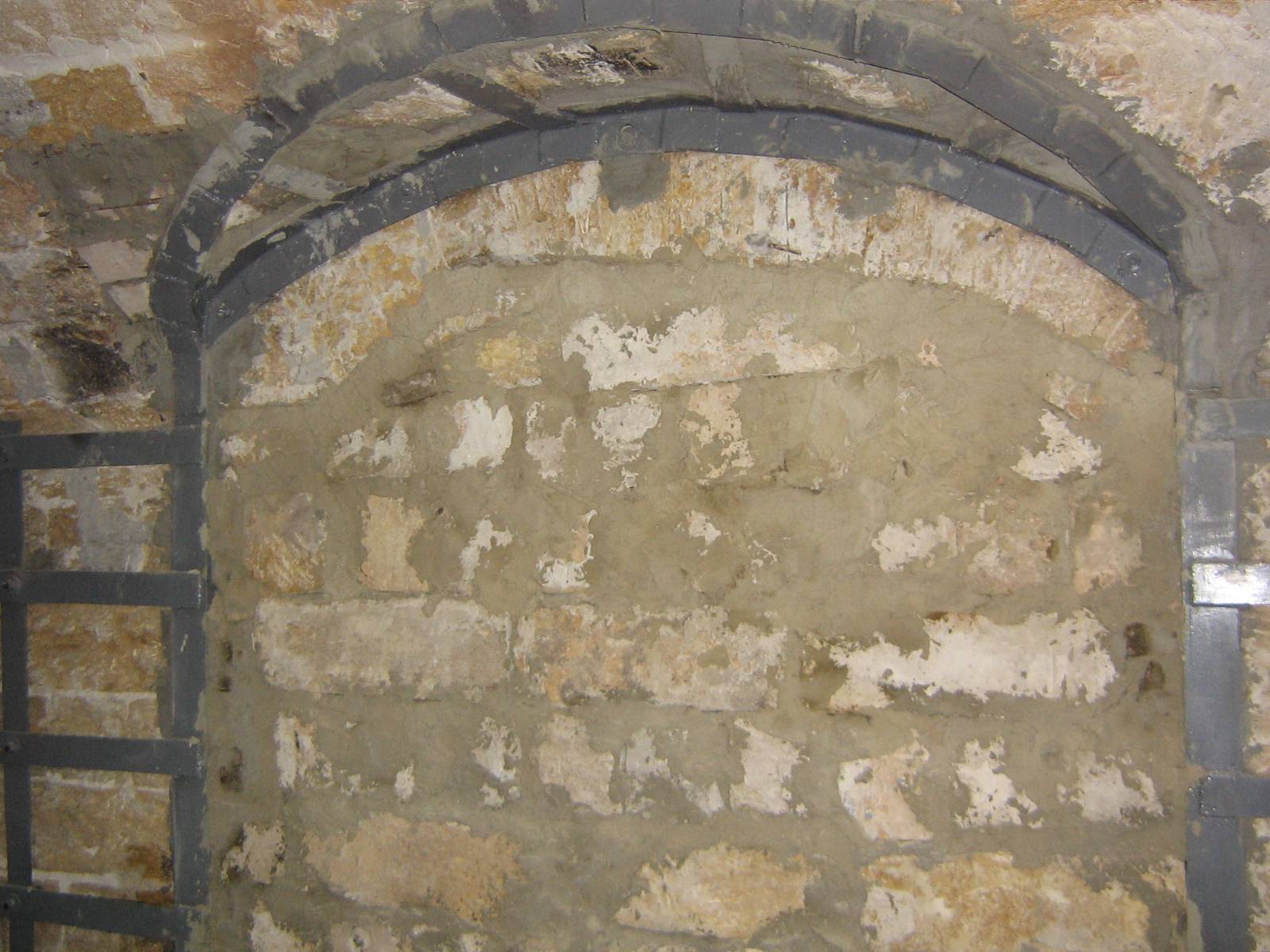
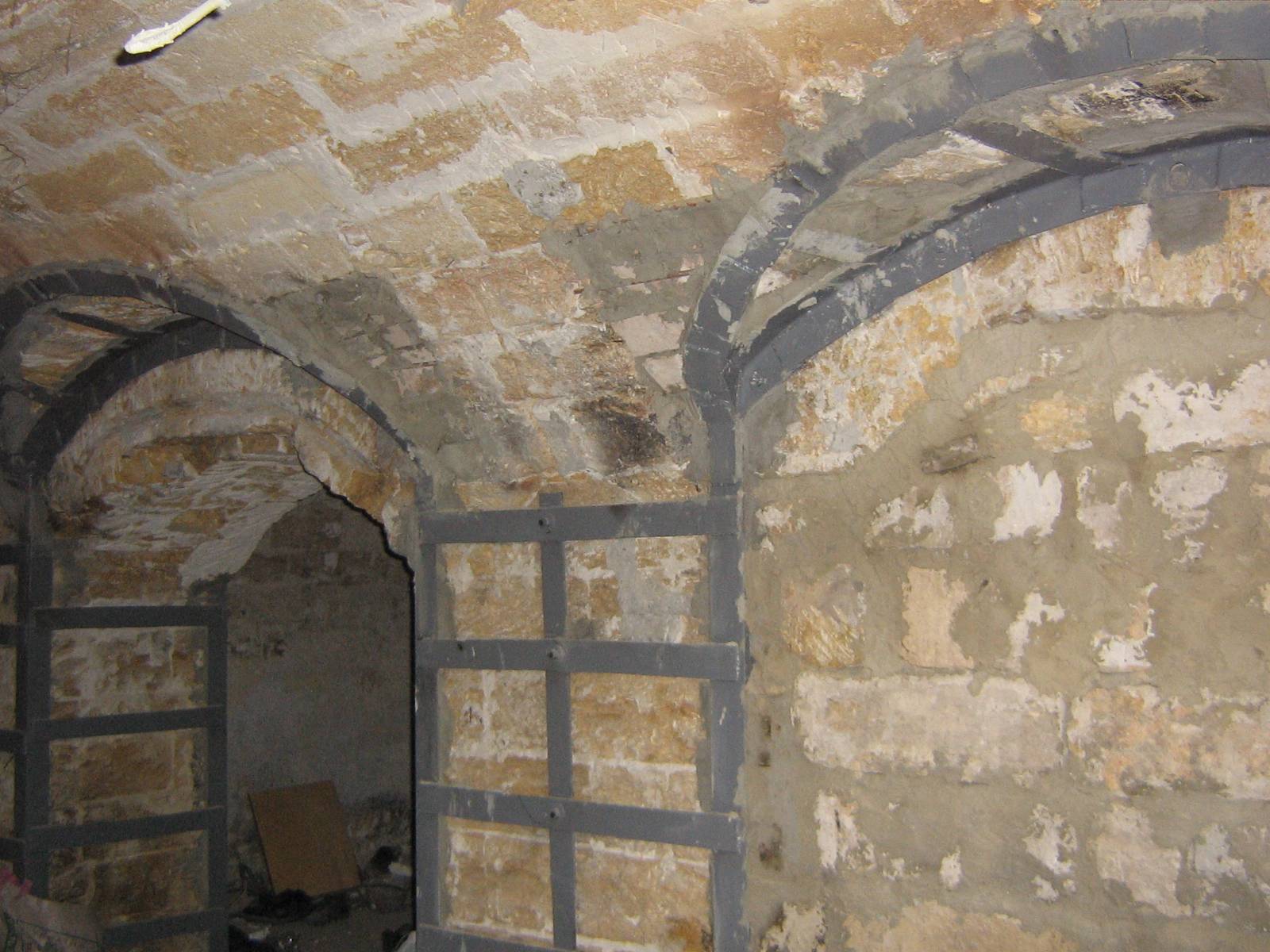
In cases when for a number of reasons the city does not manage to carry out comprehensive measures for reconstruction of a particular building in the old housing stock, and the building already clearly needs repair, a complex of emergency prevention measures is carried out, which allows extending the service life of the building until capital restoration.
/p>
Such strengthening emergency prevention works were carried out by DEHAUSS group of companies at the intersection of Lanzheronovskaya and Pushkinskaya streets, opposite the Archaeological Museum, where there is a rather interesting building with a double inner courtyard formed after an aviation shell hit part of the residential building during World War II. The floor was not restored then, additional facade windows were cut through and door openings were widened. After 70 years of operation, bulging of the courtyard wall from its plane by 170mm and crack opening by 50mm were detected. Research showed that this was also caused by rotted floor beams in places where sewage, water supply and heating systems pass, as a result of which the floors sagged, partitions and facade walls cracked, came out of their planes and the building began to tilt towards the inner courtyard.
>
During reinforcement works, it was found that during foundation laying, foundation installation works were partially not performed and in this place the foundation depth was only 40 centimeters, which led to subsequent consequences in the form of cracks and wall masonry bulging. Also an important factor was the addition of a floor during Soviet times by the then Port Chief, which overloaded the walls of lower floors.
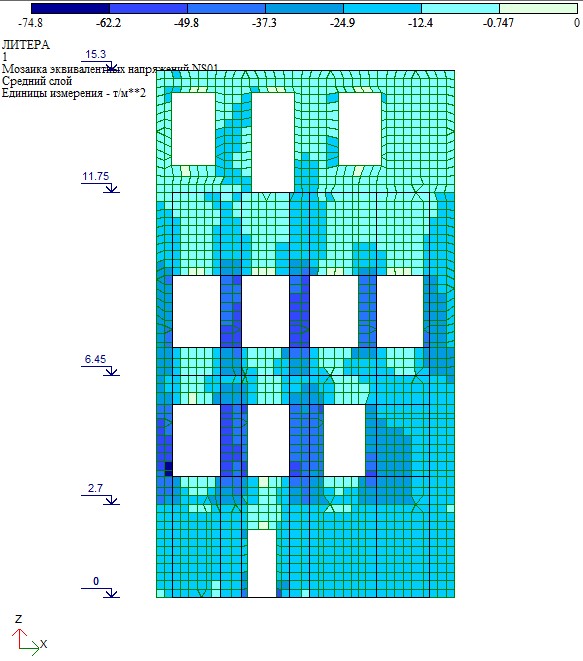
We developed and provided reinforcement of floors with metal beams followed by monolithization and installation of reinforced concrete ribbed floor slab, which was included in work together with reinforcing structures of the facade wall. We ensured wall stability during foundation strengthening works and filling of cracked piers. Reinforced structures were plastered with metal mesh.
Photo of model during development of strengthening and reconstruction project of building on Lanzheronovskaya Street.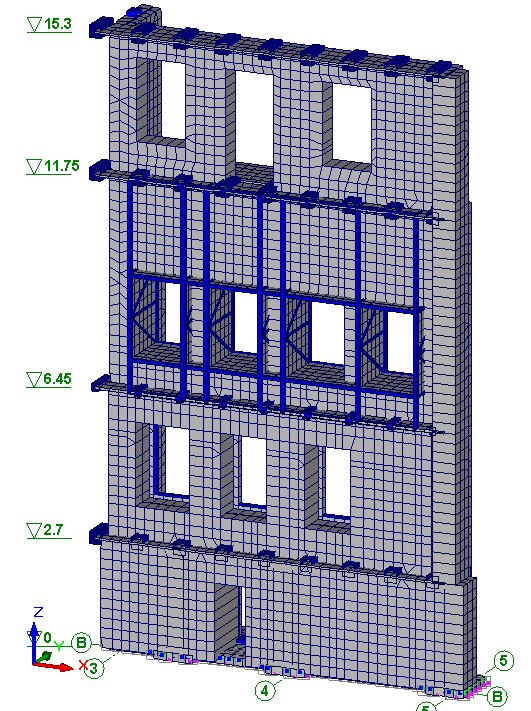
Returning to the issue of construction companies’ responsibility, we advocate for a community/business/local government cooperation program, the essence of which would be a city agreement with developers on quarterly or “courtyard” reconstruction of part of the housing stock in exchange for the right to add square meters within the reconstructed quarter, in order to obtain further economic benefits.
This way it will be possible to provide all problematic housing stock with restoration works, and do this in a single, pre-thought-out architectural scenario.
We note the positive experience in implementing city programs for courtyard improvement, network repair, facades and restoration of housing stock and infrastructure, which are carried out under the leadership of Mayor Gennady Trukhanov and improve the life of our children in courtyards and houses! But the city lacks systematicity and a comprehensive approach in solving this issue.
In our opinion, the issue of debureaucratization and formation of a new program to simplify the procedure for restoration of old buildings can become a significant shift and pave the way for implementation of a comprehensive restoration program for the historical part of Odessa’s housing stock.
Our partners from Kyiv, Chernihiv and Odessa also share their experience and opinion on the pages of PRAGMATIKA magazine